
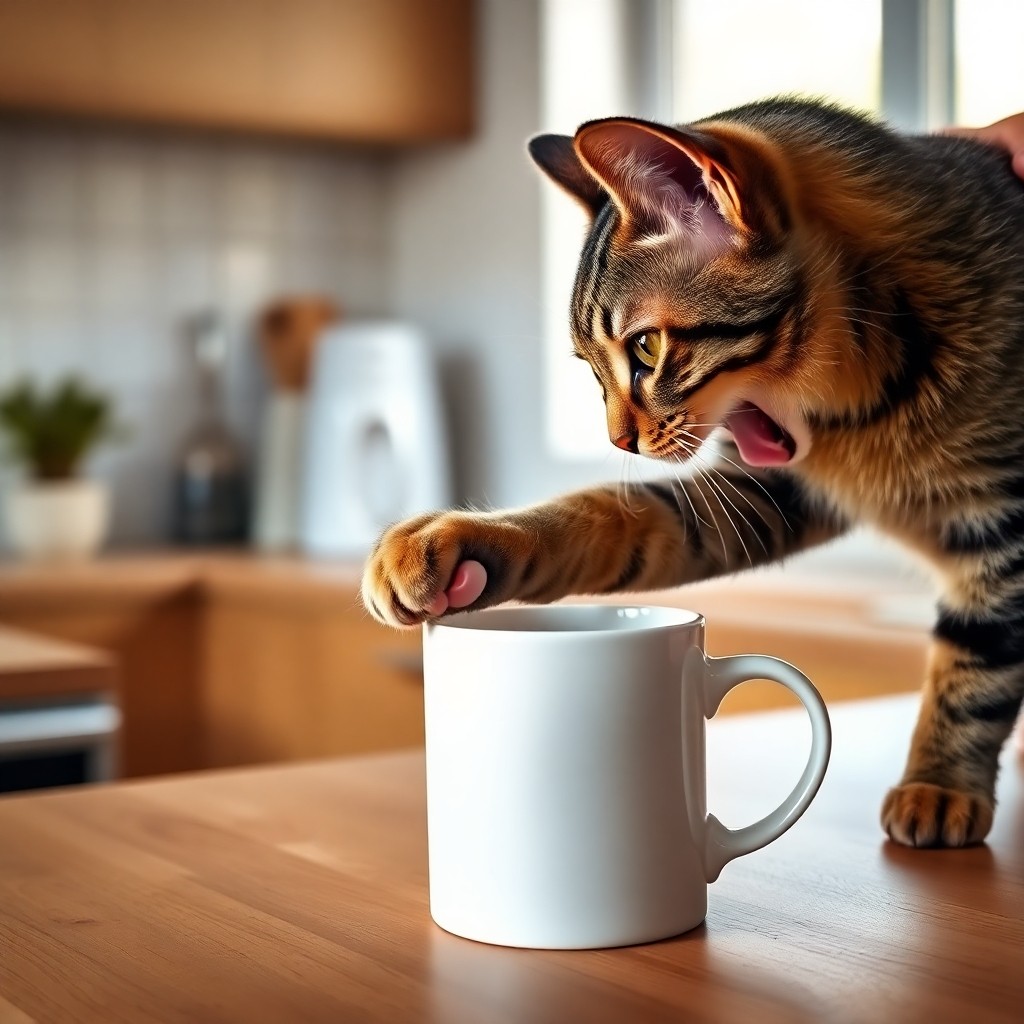
If you have ever watched your cat lock eyes with you, slowly lift a paw, and deliberately shove a glass of water off the edge of the table, you know it feels entirely personal. That sudden crash is rarely an accident; it is a calculated performance. The moment you jump up to scold them or snatch the item away, your cat realizes they have unlocked the ultimate cheat code for instant human room service.
Cats knock things off tables primarily due to their natural prey drive (testing if an object is alive), curiosity, and learned attention-seeking behavior. When they swat at a pen, a glass, or a set of keys, they are acting on deep-seated evolutionary instincts that dictate how they interact with their environment.
The Feline Psychology of the ‘Swat’
To modify this behavior, we must first understand what motivates it. Your cat isn’t acting out of malice or spite. Instead, several key natural instincts drive this curious habit.
Prey Drive and Tactile Investigation
Cats are natural predators. In the wild, they use their highly sensitive paws to test small, moving objects to see if they are alive, injured, or safe to eat. When a cat taps a pen on your desk, they are performing a predatory assessment. If the object moves or tumbles, it mimics the movement of fleeing prey, which triggers a highly satisfying instinctual reward.
The Attention Jackpot
If your cat knocks a glass of water off the nightstand at night, what do you do? You jump out of bed, speak to them, and perhaps even feed them to keep them quiet. To a cat, even a negative reaction like a scold is still high-value attention. They quickly learn that if they want you to look at them, they simply need to locate the nearest small object and push it over the edge.
Under-stimulation and Boredom
Indoor cats often lack the physical and mental stimulation they need to thrive. If their environment is static, they will create their own entertainment. Watching a lipstick tube roll, bounce, and shatter is a dynamic event in an otherwise quiet afternoon.
How to Stop the Behavior: A Step-by-Step Action Plan
Breaking this habit requires a consistent, proactive strategy. Use this practical training protocol to redirect your cat’s energy and protect your breakables.
- Step 1: Remove the Temptation. Clear your tables, desks, and nightstands of loose, small items. Keep pens, keys, and hair ties in drawers, and switch to heavy, stable mugs that cannot be easily tipped.
- Step 2: Ignore the Behavior Completely. If your cat does manage to knock something over, do not look at them, do not yell, and do not pick up the object immediately. Walk out of the room. Removing your presence deprives them of the attention jackpot.
- Step 3: Enrich Their Environment. Provide interactive toys that mimic the movement of prey. Puzzle feeders, automated laser toys, and daily structured play sessions with a feather wand will drain their excess predatory energy.
- Step 4: Reward Calm Behavior. Catch your cat being good. When they walk past a table without touching anything, or when they lie down quietly, offer a high-value treat. This teaches them that calm behavior yields better rewards than destructive habits.
Common Mistakes to Avoid
- Reacting with anger: Yelling or spraying water only breeds anxiety and damages your bond, while still providing the attention the cat was seeking.
- Using inconsistent rules: If you laugh at the behavior one day and get angry the next, your cat will become confused and continue testing boundaries.
- Neglecting mental stimulation: Expecting a high-energy cat to sit quietly without providing alternative outlets for their hunting instincts is unrealistic.
Frequently Asked Questions
Do cats understand gravity?
While cats do not comprehend the physics of gravity, they absolutely understand cause and effect. They know that tapping an object near an edge will cause it to fall to the floor, creating both a visual stimulus and a sound.
Is my cat knocking things over out of spite?
No. Spite is a complex human emotion. Cats act based on instinct, curiosity, and learned reinforcement. They do it because it is fun, natural, or because they know it gets you to interact with them.