

When a cat or dog starts showing subtle signs of lethargy, tacky gums, or a dull coat, chronic dehydration might already be quietly taking a toll on their kidneys. Fortunately, switching up how they get their water can completely change that trajectory. Tuning into these early physical cues gives you the chance to step in with better hydration habits before minor thirst turns into lasting organ stress.
A triple-action carbon filtration ceramic drinking fountain prevents chronic dehydration by continuously removing taste-inhibiting impurities, heavy metals, and organic debris while utilizing a hygienic, non-porous ceramic surface that inhibits bacterial biofilm growth, thereby stimulating a pet’s natural drive to drink.
Clinical Recognition of Chronic Dehydration in Companion Animals
Dehydration in companion animals is frequently misdiagnosed in its early stages because the clinical markers can be remarkably subtle. Unlike acute dehydration, which presents with obvious hypovolemic shock, chronic dehydration develops over weeks or months. This prolonged deficit in total body water leads to cellular desiccation, compromised metabolic waste clearance, and progressive strain on the renal parenchyma.
To identify this condition, veterinary professionals utilize several clinical markers, including skin turgor (the ‘skin tent’ test), capillary refill time (CRT), and mucosal moisture. For owners, this means that waiting until a pet is visibly weak or panting is a dangerous strategy; instead, checking for sticky, dry gums or observing if the skin over the shoulder blades takes more than one second to snap back into place can provide an early warning of systemic water loss.
The Renal and Systemic Hazards of Prolonged Fluid Deficits
When daily fluid intake consistently falls below physiological requirements, the kidneys must work exponentially harder to concentrate urine and conserve systemic water. This chronic compensatory mechanism accelerates the degradation of nephrons, potentially leading to Chronic Kidney Disease (CKD) or worsening Feline Lower Urinary Tract Disease (FLUTD). According to clinical nutrition guidelines established by international bodies (AAHA), maintaining fluid homeostasis is the single most critical dietary factor in preventing feline urologic syndromes.
Urinary stasis is another direct consequence of low water consumption. When urine remains highly concentrated and stagnant in the bladder, microscopic minerals precipitate out of solution, forming crystals (such as struvite or calcium oxalate) that can coalesce into life-threatening urethral obstructions. Ensuring a continuous source of highly palatable, moving water directly addresses the primary behavioral root cause of these medical emergencies: voluntary fluid aversion.
How Triple-Action Carbon Filtration Ceramic Fountains Solve the Hydration Crisis
Standard stagnant water bowls fail to satisfy the evolutionary instincts of domestic dogs and cats, who naturally associate standing water with bacterial contamination. Dynamic, flowing water sources overcome this instinctual barrier, but the material construction and filtration quality of the water delivery system are critical parameters governing safety and efficacy.
Ceramic construction is clinically superior to plastic alternatives. Plastic water dishes easily develop microscopic scratches over time, creating highly hospitable niches for pathogenic bacterial biofilms (such as Pseudomonas or E. coli) that cannot be fully sanitized. Non-porous, heavy-duty glazed ceramic offers a perfectly smooth surface that is highly resistant to bacterial adhesion and can be easily sterilized at high temperatures.
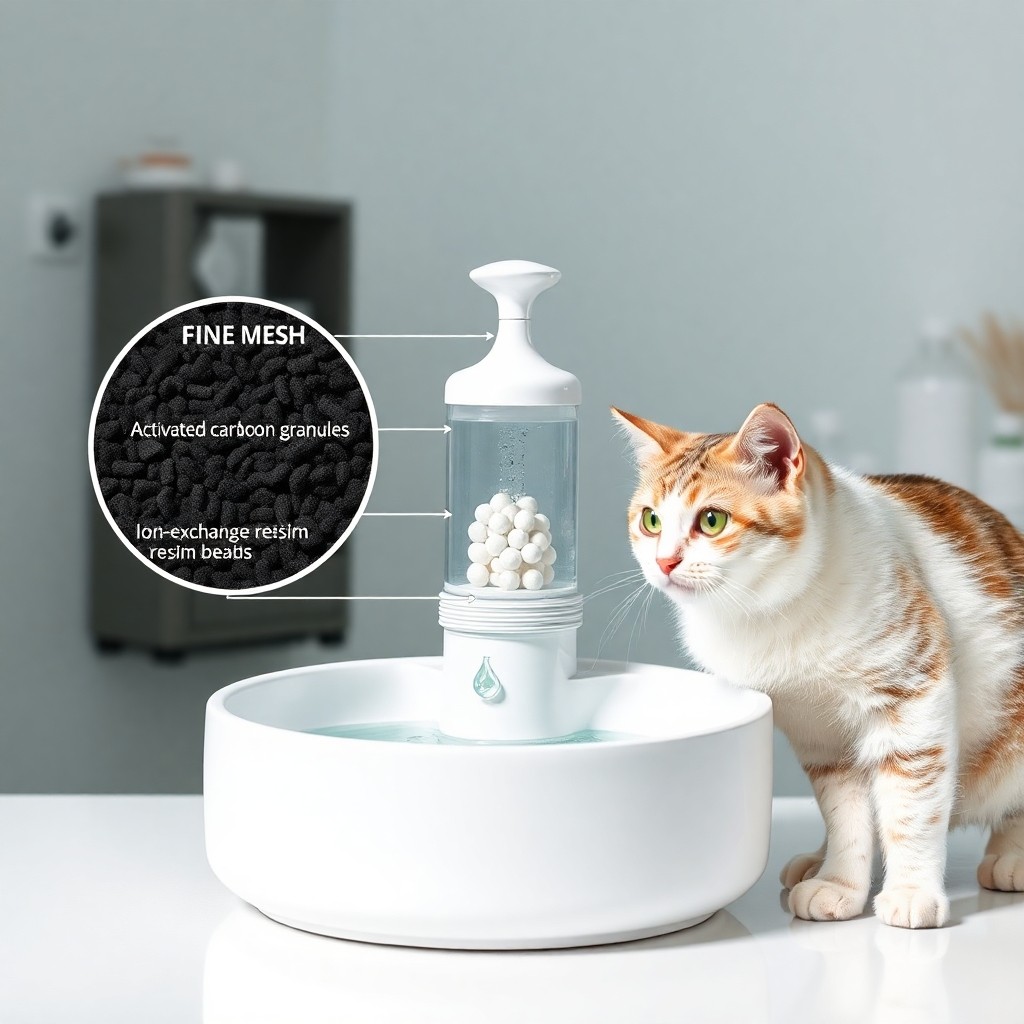
To ensure optimal palatability and chemical purity, the fountain must utilize a multi-stage filtration protocol. The triple-action filtration mechanism functions through three distinct physical and chemical barriers:
- Stage 1: Mechanical Mesh. A dense outer micro-mesh layer intercepts suspended physical debris, including pet hair, dander, and unconsumed food particles, preventing them from recirculating or clogging the water pump.
- Stage 2: Activated Carbon. High-grade activated carbon granules absorb chlorine, volatile organic compounds (VOCs), and environmental odors. For owners, this means the water loses any synthetic chemical taste or smell that would otherwise repel a pet’s sensitive olfactory system.
- Stage 3: Ion-Exchange Resin. This chemical filtration layer targets dissolved hard-water minerals (specifically calcium and magnesium ions), exchanging them for sodium or hydrogen ions to soften the water, which reduces the metabolic load on the pet’s kidneys and helps prevent urinary crystal formation.
Hydration Requirements and Diagnostic Indicators Table
To help monitor companion animals, the following clinical table outlines normal hydration parameters, diagnostic ranges, and recommended daily fluid intakes based on weight under standard physiological conditions (WSAVA):
| Parameter / Metric | Optimal Physiological Range | Borderline / At-Risk Range | Clinical Intervention Required |
|---|---|---|---|
| Feline Daily Fluid Intake | 50 – 60 ml per kg of body weight | 35 – 49 ml per kg of body weight | Less than 35 ml per kg of body weight |
| Canine Daily Fluid Intake | 60 – 70 ml per kg of body weight | 45 – 59 ml per kg of body weight | Less than 45 ml per kg of body weight |
| Capillary Refill Time (CRT) | Under 1.5 seconds | 1.5 – 2.0 seconds | Greater than 2.0 seconds |
| Urine Specific Gravity (USG) – Cats | 1.035 – 1.050 | 1.051 – 1.060 (concentrated) | Greater than 1.060 or persistently dilute |
Long-Term Management and Fountain Maintenance Protocols
To guarantee the long-term efficacy of a triple-action filtration system, strict sanitary maintenance must be observed. While the ceramic housing limits bacterial growth, the continuous filtration of organic debris means the filter cartridges will eventually saturate. Under normal domestic conditions, the triple-action filter cartridge should be replaced every three to four weeks, and the water pump must be disassembled and descaled monthly using food-safe citric acid or white vinegar to prevent mineral buildup from burning out the motor.
When to Escalate to Veterinary Clinical Care
While maximizing hydration through advanced filtration is an excellent preventative strategy, it is not a cure for advanced systemic disease. If a pet displays sudden polydipsia (excessive drinking) coupled with polyuria (excessive urinating), weight loss, or persistent vomiting, these are clinical indicators of metabolic disorders such as diabetes mellitus, hyperthyroidism, or advanced stage renal failure. In such instances, immediate veterinary consultation and a comprehensive diagnostic panel are mandatory.
References
American Animal Hospital Association (AAHA). AAHA Nutritional Assessment Guidelines for Dogs and Cats. Journal of the American Animal Hospital Association.
World Small Animal Veterinary Association (WSAVA). WSAVA Global Nutrition Committee Nutritional Assessment Guidelines.
Frequently Asked Questions
How often should the triple-action filters be replaced?
For a single-pet household, the filter cartridge should be replaced every 3 to 4 weeks. In multi-pet households, or if the water has a high mineral content, replacing the filter every 2 weeks is recommended to maintain optimal purification.
Why is ceramic superior to plastic for preventing feline acne?
Ceramic is non-porous and highly resistant to scratching, which prevents pathogenic bacterial biofilms from colonizing the surface. Plastic dishes easily develop microscopic scratches that harbor bacteria, leading to chin pyoderma (feline acne) when the pet’s chin contacts the bowl.
Can hard tap water damage the filtration fountain?
Yes. Heavy mineral deposits can accumulate inside the water pump, causing friction and motor failure. Utilizing the ion-exchange resin layer of a triple-action filter significantly mitigates this risk, though regular pump descaling is still required.