

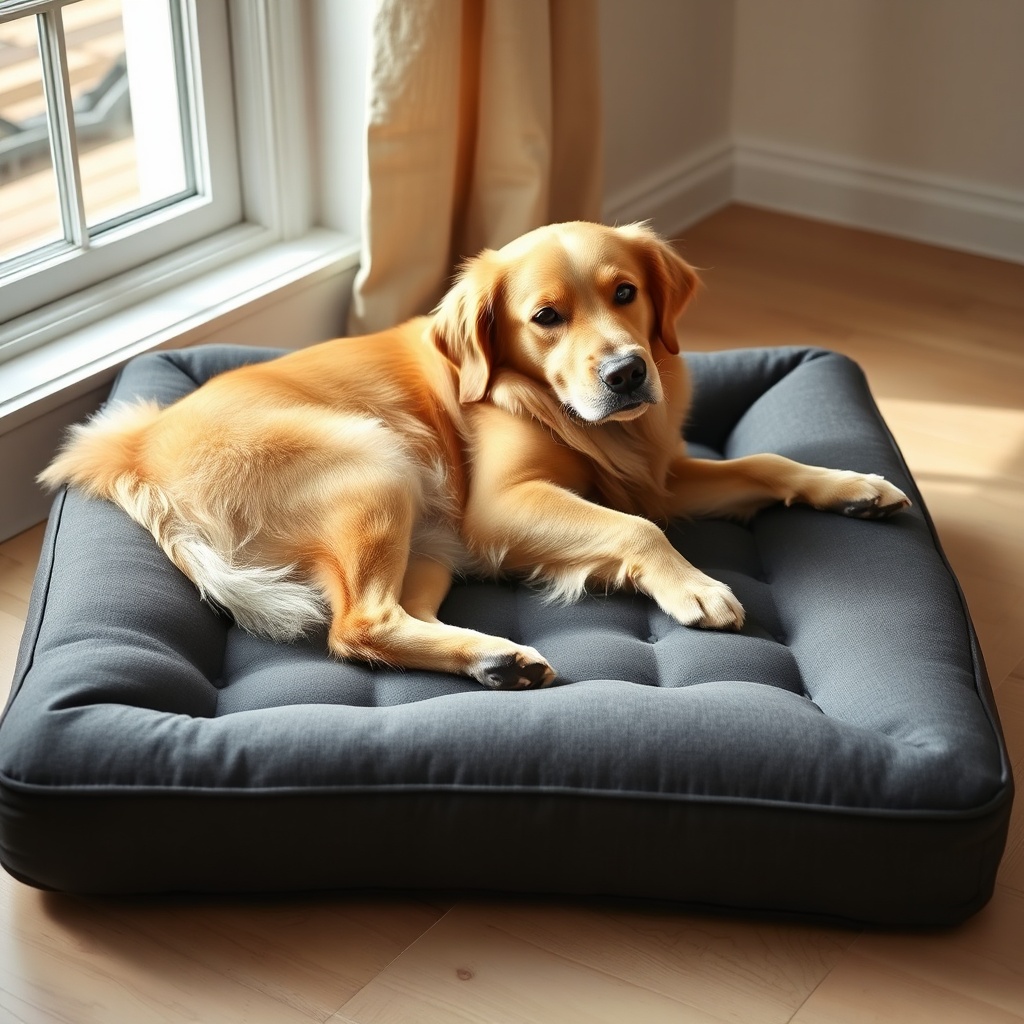
Picture your big senior dog trying to stretch out comfortably, only to realize their hips are hanging off the edge of the mattress and their aching joints are still pressing hard against the floor. Choosing the right orthopedic bed for a large breed isn’t just about matching a weight limit on a tag; it requires looking closely at how your dog actually sleeps, moves, and needs support as they age.
To find the perfect orthopedic bed size, measure your dog from the tip of the nose to the base of the tail for length, and from the crown of the head or shoulder to the paw pad for height, then add 6 to 12 inches to these measurements to establish the minimum mattress length and width. This ensures your pet has ample room to stretch out fully without their joints resting on the cold, hard floor.
Why Standard Sizing Fails Senior Large Breed Dogs
Standard dog beds are often categorized simply as ‘Large’, ‘Extra Large’, or ‘Giant’. While these labels might work for young, healthy dogs who can easily curl into tight balls, they are often inadequate for aging canines. As large breed dogs age, conditions like osteoarthritis, hip dysplasia, and degenerative myelopathy cause chronic joint pain and muscle stiffness. These physical limitations change how they rest.
Senior dogs need more physical space because they struggle to curl up tightly. Curling requires joint flexion, which is painful for arthritic hips and elbows. Instead, senior dogs prefer to sprawl out flat on their sides to distribute their body weight evenly and relieve pressure points. If a bed is too small, their heavy limbs will spill over the edges, pressing directly onto the hard floor and defeating the purpose of an orthopedic mattress.
The Step-by-Step Sizing Protocol
To prevent purchasing a bed that forces your senior dog into an uncomfortable sleeping posture, follow this precise three-step measurement protocol:
- Step 1: The Nose-to-Tail Measurement (Sleeping Length) – Locate the tip of your dog’s nose and measure in a straight line to the base of their tail (where the tail meets the lower back). Do not measure to the end of the tail itself. Add 6 to 8 inches to this number to find the minimum length of the bed.
- Step 2: The Shoulder-to-Floor Measurement (Sleeping Width) – When your dog is lying down comfortably on their side, measure from the top of their shoulder blades (the withers) down to their paws. Add 6 to 12 inches to this measurement to determine the minimum width of the bed. This buffer allows for natural leg extension.
- Step 3: The Entry Height (Thick Support Layer) – For senior large breeds, a bed must be thick enough to prevent bottoming out. Look for a minimum thickness of 4 to 6 inches of high-density orthopedic foam. Additionally, make sure the step-in height is not so high that it trips a dog with hind-limb weakness.
Orthopedic Sizing Matrix for Large and Giant Breeds
The following table outlines the minimum dimensions and foam thickness required based on physical size and common large breeds:
| Breed Type / Example | Weight Range (lbs) | Recommended Bed Dimensions (Inches) | Minimum Foam Thickness |
|---|---|---|---|
| Labrador, Golden Retriever, Boxer | 60 – 80 lbs | 36 x 28 inches (Large) | 4 inches |
| German Shepherd, Rottweiler, Husky | 80 – 110 lbs | 44 x 35 inches (XL) | 5 inches |
| Great Dane, Mastiff, Irish Wolfhound | 110+ lbs | 50 x 36 inches or larger (XXL) | 6 inches |
Crucial Support Factors: Foam Density and Bolster Space
Sizing is not just about length and width; thickness and structural design play equal roles in orthopedic success. True orthopedic beds utilize two primary layers: a highly dense support foam base and a pressure-relieving memory foam top layer. Cheap, shredded foam or thin polyester fill will compress instantly under a 90-pound dog, leaving their sore joints resting directly on the hard floor.
If you choose a bed with built-in bolsters (raised outer walls), you must subtract the width of the bolsters from the total mattress dimensions to find the actual ‘usable sleeping surface’. While bolsters offer excellent neck support and a sense of security, they significantly reduce the available flat area. For sprawling senior dogs, a flat, mattress-style orthopedic bed with no bolsters is often the safest and most spacious choice.
Common Mistakes to Avoid
- Buying by weight limits alone: Two dogs weighing 90 pounds can have completely different body shapes. A tall, long-bodied greyhound requires more flat surface area than a compact, muscular bulldog of the exact same weight.
- Ignoring the ‘sink’ factor: Low-quality memory foam sinks too deeply. If your senior dog sinks to the bottom, they will struggle to find traction when trying to stand up, increasing their risk of slipping and joint strain.
- Neglecting non-slip bottom features: Senior dogs often push off the bed with significant force when trying to stand. If the bed slides across hardwood or tile floors, it can cause severe slips and injuries. Ensure the bed features a high-traction, non-slip base.
Frequently Asked Questions
How thick should an orthopedic bed be for a 100-pound dog?
For a dog weighing 100 pounds, the orthopedic bed should be at least 5 to 6 inches thick. It must consist of a high-density support foam base (at least 3 inches) topped with premium memory foam to prevent the dog’s hips and shoulders from bottoming out against the floor.
Are bolster beds good for arthritic senior dogs?
Bolster beds are excellent if your dog prefers to rest their head on a pillow or lean their back against a supportive wall. However, they restrict overall movement and sleeping space. If your senior dog loves to stretch out completely flat, a flat mattress design is highly recommended.
How do I know if my dog’s bed is too small?
Your dog’s bed is too small if any part of their body (head, paws, hips, or elbows) hangs off the cushion when they are resting in their preferred sleeping position. If they consistently choose the hard floor over their bed, the mattress may be too small or failing to support their weight adequately.