
Catching your cat staring intently at an empty wall can feel a little eerie, as if they are watching a ghost. But as bizarre as it looks, that laser-focused gaze is usually driven by their extraordinary senses picking up on things completely invisible to us.
Cats stare at walls because their highly sensitive hearing and vision allow them to detect tiny sounds, microscopic insects, or light reflections that humans cannot perceive. However, persistent wall-staring in older cats can sometimes point to underlying medical issues like cognitive decline or vision loss.
The Sensory Superpowers Behind the Stare
Before assuming there is a behavioral or medical issue, it is vital to understand that a cat’s sensory window to the world is vastly different from ours. What looks like a blank, empty drywall to a human is often a bustling canvas of sensory data to a feline.
- Ultra-Sensitive Hearing: Cats can hear high-frequency sounds that are completely inaudible to human ears. They can easily detect the faint rustling of pests inside the walls, the vibration of pipes, or the hum of electrical wiring.
- Advanced Visual Processing: While cats do not see colors as vividly as we do, their eyes are highly adapted to detect microscopic movement and low-light changes. A cat staring at a seemingly blank spot is often tracking a tiny dust mote floating in a sunbeam, a minuscule spider, or a shifting shadow cast by outdoor traffic.
- Ultraviolet Vision: Research suggests that cats can see certain wavelengths of light in the ultraviolet spectrum. This means they can spot reflections and patterns on wall paint that remain entirely invisible to human eyes.
Common Behavioral Motivations
Cats are natural-born predators, and much of their daily routine is governed by hunting instincts. Even pampered indoor cats retain these deep-seated drives, which frequently manifest in wall-staring episodes.
The Predatory Freeze
When a cat detects potential prey—such as a tiny gnat on the ceiling or a beetle crawling along the baseboard—their immediate instinct is to freeze and observe. This absolute stillness allows them to calculate distance and prepare for a potential pounce. During this phase, they may stare at a single spot on the wall for several minutes without moving a muscle.
Playfulness and Curiosity
Sometimes, a reflection from a watch face, a smartphone screen, or a window can cast a fleeting light beam onto the wall. Even after the light disappears, a curious cat might continue staring at the spot, waiting patiently for the ‘prey’ to reappear.
When Wall-Staring Signals a Medical Issue
While most instances of wall-staring are harmless sensory observations, there are times when this behavior warrants a visit to the veterinarian. This is especially true if the behavior starts suddenly or is accompanied by other physical symptoms.
Feline Cognitive Dysfunction (FCD)
Similar to dementia in humans, senior cats can develop Feline Cognitive Dysfunction. This condition affects memory, learning, and spatial awareness. Older cats with cognitive decline may wander into a room, become disoriented, and stare blankly at a wall or corner. For owners, this means monitoring if the staring is accompanied by loud nighttime vocalizations, confusion, or changes in sleeping patterns.
Feline Hyperesthesia Syndrome (FHS)
This is a rare neurological disorder characterized by extreme skin sensitivity. Cats suffering from hyperesthesia may stare intensely at walls, suddenly attack their own tails, vocalize loudly, or exhibit frantic grooming and skin-rippling along their backs.
Head Pressing vs. Staring
It is crucial to distinguish between a cat staring *at* a wall and a cat pressing its head *against* a wall. If a cat physically presses its forehead against a wall, furniture, or other solid objects, this is a medical emergency known as ‘head pressing’. This behavior indicates a serious neurological issue, such as brain damage, toxic poisoning, or prosencephalon disease, and requires immediate veterinary intervention.
How to Determine the Cause: An Owner’s Checklist
To help narrow down why a cat is staring at the wall, pet parents can run through this quick observational checklist:
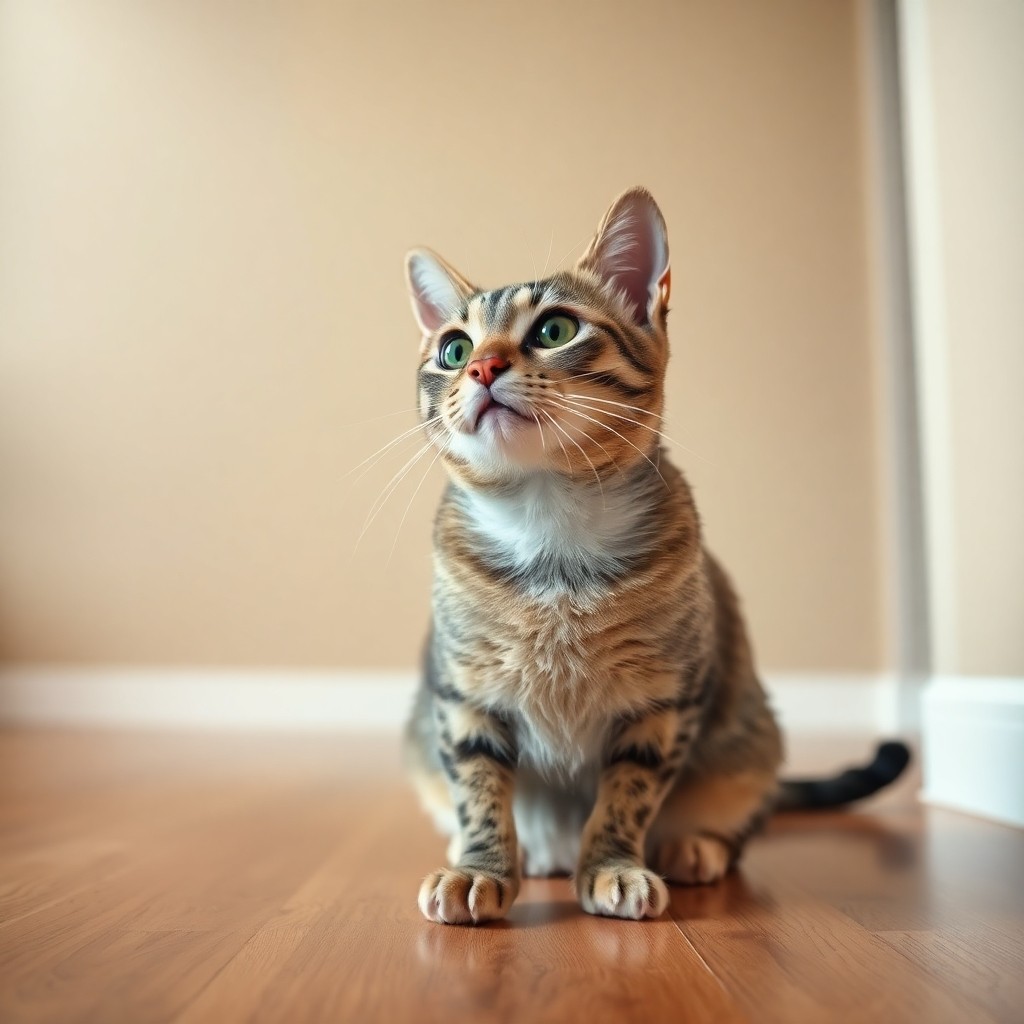
- Check the angle: Is the cat’s head tilted as if listening? If so, they are likely tracking pests or plumbing inside the drywall.
- Inspect the surface: Get close to the wall at the cat’s eye level. Look for tiny shadows, light reflections, or microscopic insects.
- Assess the cat’s age: Is the cat a senior? If they are over ten years old and show signs of disorientation, consult a veterinarian about cognitive health.
- Look for physical tension: Is the tail twitching excitedly (predatory behavior), or does the cat look tense, glassy-eyed, and unresponsive?
Frequently Asked Questions
Do cats stare at walls when they are in pain?
Yes, some cats may stare blankly at walls or into space when experiencing chronic pain or discomfort. This is often accompanied by a hunched posture, squinted eyes, and a reluctance to interact with family members.
Should I interrupt my cat when they are staring at the wall?
If the cat is simply showing normal predatory curiosity, you can gently redirect their attention with an interactive toy, like a feather wand. However, if the cat seems deeply disoriented or unresponsive when you call their name, it is best to consult a vet.